
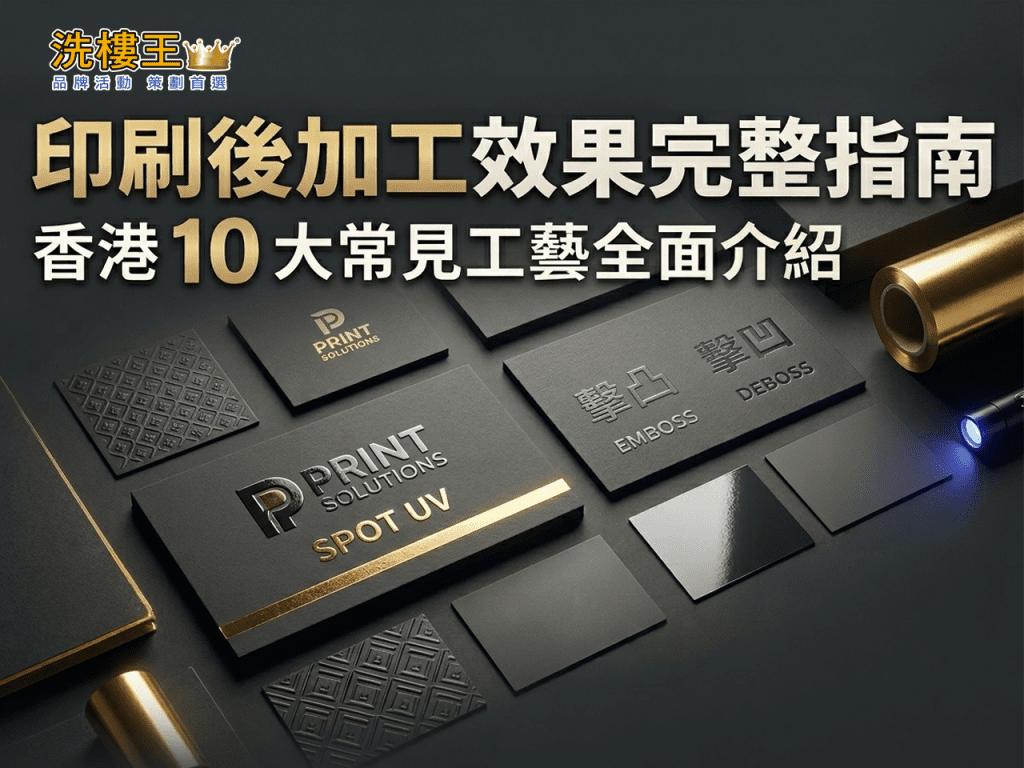
Two business cards, side by side on a table — why does one instantly draw attention while the other goes unnoticed? The answer often has nothing to do with the design itself, but everything to do with print finishing effects.
In Hong Kong, brands across retail, F&B, beauty, and corporate sectors are increasingly turning to specialty print finishing to elevate their materials, add visual depth, and make a lasting first impression. Yet faced with terms like Spot UV, foil stamping, die cut, embossing, double mounting, and edge painting, many clients aren’t sure where to begin.
This guide walks you through 10 of the most common print finishing techniques used in Hong Kong, covering what each effect is, the types available, and where it’s typically applied — so you can make the right choice for your brand.
1. Lamination — Gloss / Matte / Gloss Varnish / Matte Varnish
Lamination is the most fundamental and widely used print finishing process. Its primary purpose is to enhance the surface appearance of printed materials while offering a degree of protection.
Common types include:
- Gloss lamination: High-shine surface that boosts colour vibrancy, ideal for showcasing vivid images
- Matte lamination: Soft, low-reflection finish with a premium feel — now the go-to choice for brand business cards and luxury packaging
- Gloss varnish: Similar effect to gloss lamination at a lower cost, commonly used for large-run flyers and posters
- Matte varnish: Subtle matte finish at a lower cost than matte lamination, suitable for corporate leaflets and general commercial print
Commonly applied to flyers, posters, product catalogues, business cards, and packaging boxes. If you plan to add Spot UV, foil stamping, or other finishing effects, matte lamination is recommended as the base — it creates a sharper contrast and makes the finishing stand out more.
2. Spot UV (Localised UV Coating)
Spot UV — also referred to in the industry as “partial UV” or “spot gloss” — is one of the most popular print finishing effects among designers and brands in Hong Kong. The process involves applying a layer of transparent UV-cured coating to specific areas on a matte-laminated surface, creating a striking gloss contrast against the flat matte background.
Common types include:
- Gloss Spot UV: Produces a high-shine finish on logos, headlines, or graphics — maximum visual impact
- Matte / Satin UV: Creates a velvety, smooth-to-touch surface, ideal for high-end brands
- Raised UV (Thick UV): A thicker UV layer that adds a subtle tactile dimension, enhancing both the look and feel
Widely applied to business cards, invitation cards, product flyers, and gift box packaging. Spot UV delivers a noticeable upgrade in perceived quality without significantly increasing cost.
3. Foil Stamping (Hot Foil Stamping)
Foil stamping transfers metallic foil film onto the paper surface using a heated die, producing a brilliant metallic sheen on the designated area.
Common types include:
- Gold / Silver: The most traditional and widely used options
- Rose Gold / Copper: Popular with fashion and beauty brands
- Matte Gold: A subdued, sophisticated metallic finish
- Holographic / Rainbow Foil: Multi-colour reflective effect with strong visual impact
Widely applied to premium business cards, wedding invitations, brand packaging, corporate annual reports, and certificates. For best results, keep foil line widths at no less than 0.2mm. When combined with embossing, foil stamping can produce a striking three-dimensional metallic effect.
4. Embossing / Debossing
Embossing uses a custom die under pressure to raise selected areas of the paper surface, creating a three-dimensional relief effect. Debossing does the opposite — pressing the design downward into the paper for a more understated, tactile finish. When no ink or foil is applied to the raised or recessed area, it is known as blind embossing — letting the paper’s own texture speak for itself in a quietly luxurious way.
Common types include:
- Colour embossing: Raised areas printed with colour or combined with foil stamping for strong visual effect
- Blind embossing: Pure paper texture, low-key and premium
- Debossing: Design pressed into the surface for a calm, refined look
Commonly applied to premium business cards, wedding invitations, luxury packaging boxes, and book covers. A paper weight of 250gsm or above is recommended for the best three-dimensional result.
5. Die Cut (界字 / 啤版)
Known in Hong Kong’s print industry as “界字” (gaai jih) or colloquially as “啤版” (be-baan), die cutting uses a custom steel blade die to cut printed materials into any desired shape — breaking free from the standard rectangle.
Common types include:
- Custom shape cutting: Circles, ovals, or any bespoke silhouette
- Corner rounding: Straight corners cut into a curved arc; common radii are 3mm, 5mm, and 8mm
- Custom-form packaging boxes: Structural shapes tailored to the product
Commonly applied to shaped business cards, brand stickers, custom hangtags, gift cards, and packaging boxes. Suitable for paper stock of 157gsm and above; always allow for bleed and safe zones in the design.
6. Double Mounting
Double mounting bonds two sheets of different materials or colours together, producing a thicker, more substantial finished piece.
Common types include:
- Printed sheet + colour stock: Creates a two-tone contrast, with the reverse showing a brand colour or specialty paper
- Printed sheet + specialty paper (cotton paper, pearlescent paper): Significantly elevates the tactile quality
- Heavy-duty laminate mounting: Makes packaging boxes and gift boxes more rigid and durable
Commonly applied to premium business cards, wedding invitations, and luxury packaging. It’s one of the most effective ways to raise perceived quality without requiring complex print techniques.
7. Edge Painting
Edge painting applies colour to the trimmed sides of paper stock, adding a layer of visual richness and a premium feel to business cards and other printed pieces.
Common types include:
- Gold edges: The most popular choice, suited to high-end brands
- Silver edges: Pairs well with cool-toned design palettes
- Black / Red edges: Bold contrast for a strong, characterful look
- Brand colour edges: Matched to brand guidelines for a cohesive identity
Increasingly popular in Hong Kong’s premium business card market in recent years. For best results, edge painting works best on double-mounted thick stock (approximately 300gsm or above), which provides sufficient surface area for the colour to show clearly.
8. Scoring and Folding
When printed materials need to be folded — especially on heavier stock — a scored crease line must be applied first to prevent cracking or white lines along the fold.
Common fold types include:
- Half fold (bi-fold): The most common, used for greeting cards and folded business cards
- Tri-fold (letter fold): Standard for brochures and product catalogues
- Z-fold (accordion fold): Alternating fold direction, commonly used for multi-panel leaflets
- Cross fold (quarter fold): Folded into four panels, suitable for booklets
Commonly applied to folded business cards, event invitation cards, book/brochure covers, and product catalogues.
9. Hole Punching
Hole punching creates an opening at a designated point on the printed piece, allowing for cord threading, clip attachment, or binding.
Common types include:
- Round hole: The most common type, used for hangtags and ID badges
- Oval hole: For specific design requirements
- Multi-hole punching: For binding or suspension purposes
Commonly applied to event lanyards and ID badges, product hangtags, wall calendars, and gift cards. Always allow sufficient space around the hole in the design to avoid cutting into important content.
10. Laser Die Cut
Laser die cutting is a rapidly growing finishing technology in the digital print market. Unlike traditional die cutting, which requires a physical steel blade die, laser die cutting uses a high-precision laser beam to cut directly from the digital artwork file — no tooling required, making it well-suited to short runs and personalised projects.
Common types include:
- Custom outline cutting: Cuts any complex shape with exceptional precision
- Hollow-out (cut-through) effects: The laser cuts intricate patterns or lettering through the material, creating a see-through perforated effect. When combined with double mounting, the hollow areas reveal the colour or texture of the backing layer beneath — adding striking depth and dimension. This technique is especially popular for premium invitation cards and luxury packaging
- Score engraving (kiss cut): Partial cuts that don’t go all the way through, allowing sections to be folded back or peeled open
Commonly applied to hollow-out invitation cards, shaped business cards, luxury packaging boxes, specialty hangtags, and artistic book covers. Compared to traditional die cutting, laser is particularly suited to small quantities and projects requiring fine, intricate hollow-out detail; for high-volume runs, traditional die cutting generally remains more cost-effective.
Combining Print Finishing Effects
Print finishing techniques are not mutually exclusive — in fact, the most memorable printed pieces often use two or three effects in combination. Here are some of the most popular pairings in the Hong Kong market:
| Combination | Best For | Effect |
|---|---|---|
| Matte lamination + Spot UV | Business cards, product booklets, invitations | Strong gloss contrast, premium feel |
| Matte lamination + Foil Stamping + Embossing | Premium cards, wedding invitations, gift boxes | Three-dimensional metallic luxury |
| Double mounting + Edge painting | Luxury business cards | Substantial weight, visible colour on all edges |
| Die cut + Spot UV | Shaped stickers, hangtags | Distinctive form with localised gloss accents |
| Laser die cut + Foil stamping | Premium invitations, wedding stationery | Hollow-out patterns with metallic sheen, rich visual layering |
| Laser die cut + Double mounting | Premium business cards, brand cards | Hollow-out reveals backing colour or texture |
| Laser die cut + Spot UV | Creative promo cards, product hangtags | Hollow-out paired with gloss coating for visual focal points |
| Matte lamination + Blind embossing | Luxury packaging, premium book covers | Quiet luxury — texture speaks for itself |
That said, more is not always more. Over-layering techniques can cause a design to lose its focus. As a general rule, one to three core finishing effects per piece — chosen to complement the overall design and brand positioning — tends to deliver the strongest result.
Final Thoughts
Whether you’re preparing materials for a brand campaign, product launch, trade exhibition, or corporate identity refresh, choosing the right print finishing effect is often what makes the difference between a piece that gets noticed and one that gets forgotten.
From essential finishes like gloss and matte lamination, to advanced techniques such as Spot UV, foil stamping, embossing, and laser die cutting — each method brings its own distinct value. The key is matching the right techniques to your budget, brand identity, and intended use.
If you’d like to explore which finishing effects are right for your next print project, or would like a tailored recommendation for your brand, feel free to get in touch. Our team will advise on the most suitable options based on your brand direction, print quantity, and budget.
Print Finishing Makes All the Difference — Upgrade Your Print Materials Today|contact Flyer King ›